





R&D MINUTE
BEHIND THE SCENES OF PRODUCT DEVELOPMENT

Imagination, design, constraints, materials, and technologies are at the heart of the new product creation process. Adrien Guillon, Product Development & Marketing Manager, and Antoine Tirmarche, Materials Manager, take us behind the scenes of developing a new product range.
Adrien Guillon: We plan several years in advance! We first decide on the direction to take and what we want the brand to look like tomorrow. We start setting down product concepts, personal aspirations, feedback or recommendations from athletes, and even gaps to be filled in the market. Then, we organize our ideas and challenge them. We ask ourselves why no one has done this before and discard the ideas we find useless. We think about range consistency and the values we want to convey. We must also size the range according to constraints and team capacities. Once the plan is set, we list the needs: technological building blocks, associated constraints, and necessary resources. Even if everything is "planned," nothing is immutable, and a product might be postponed if we don't deem it finished within the allotted time.
AG: Several constraints add up. When creating a new product, we face the constraint of technological building blocks—that is, all the expertise required to realize this new product. This process takes us through phases of research followed by the development of new technologies, as was the case for our waterproof-breathable membrane. Then, there is the timing constraint. We must manage to develop a finished product on time according to the market release schedule, while including the various phases of development, prototyping, field tests, and athlete feedback.
We also have the supply chain constraint, which requires having the right suppliers and the right factories, capable of manufacturing our products in all their technical complexity.
Minimum order quantities are also a fundamental element in this process. Working on exceptional products with very specific uses, our volumes are de facto lower than the norm. However, we must ensure a minimum produced quantity to be able to ensure industrial production and, before that, to order a sufficient quantity of material in the eyes of our suppliers (especially in the case of a custom development).
Price is also a key factor. Succeeding in maintaining a viable production cost for the product's commercialization is essential and constitutes a heavy constraint when dealing with high-end materials.
Finally, our last constraint is succeeding in linking the specific performance needs of our athletes with the needs of our customers, which sometimes differ.

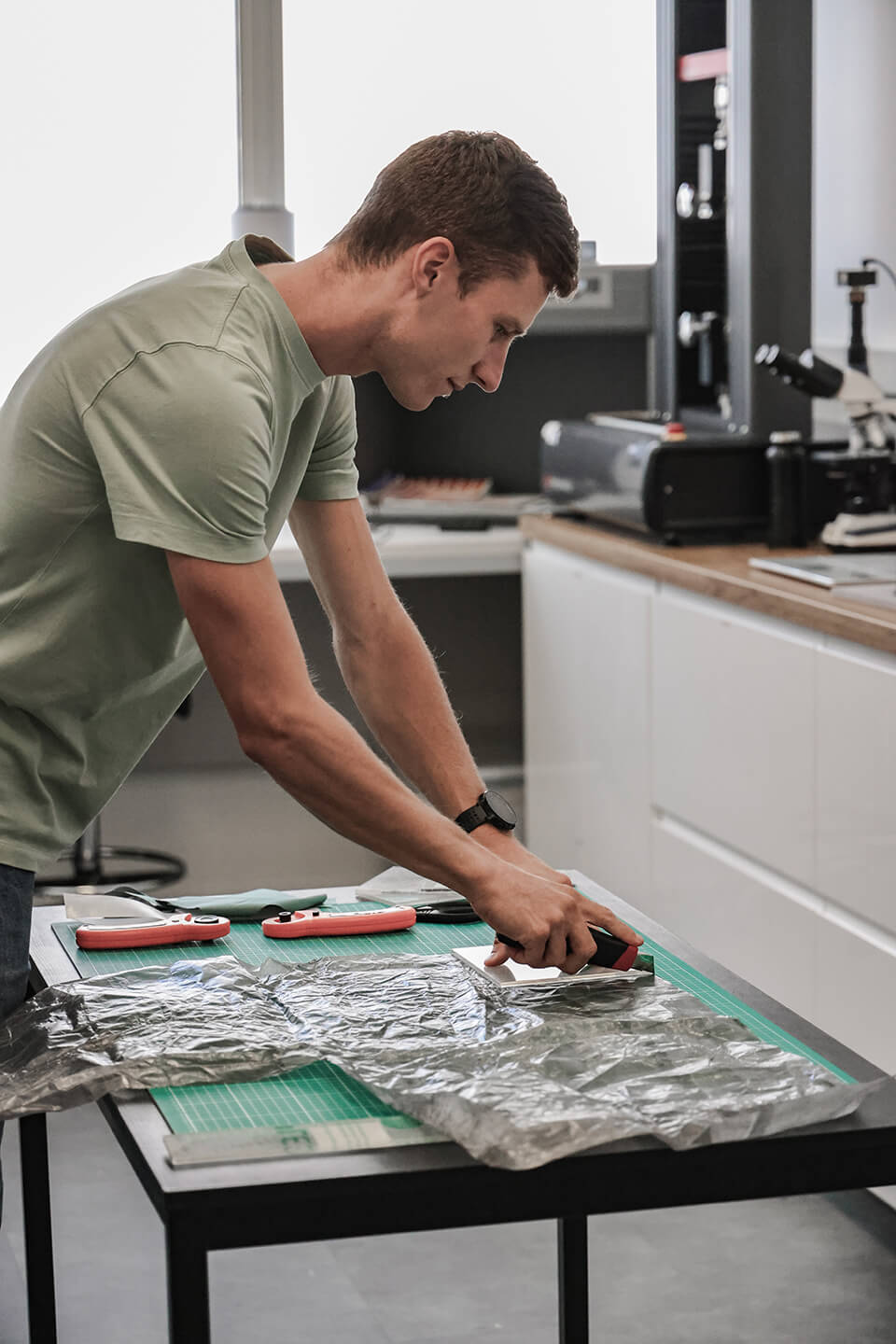
Antoine Tirmarche: First, the product brief imposes a specific use and therefore constraints related to its environment, which guides our selection of the materials and technologies to use for the product. If it turns out that materials or technologies we already use are adapted to the new product, we select them because they have already been proven in the field. We find consistency and timelessness in that.
Otherwise, we launch into a development loop. This is characterized first by the establishment of specifications for these materials and technologies, in line with the functional needs of the product. Materials are sourced and/or developed in accordance with these specifications at our suppliers. Then, they are tested in the laboratory (pure performance) and in the field (durability) to validate their viability for the product. Finally, we use these materials during the prototyping phase to test them on products in real-world use.
In some cases, a "simple" development loop is not enough to obtain a material or technology on time. Thus, as the collection plan is available several seasons in advance, needs for complex materials and technologies are identified directly. Therefore, R&D actions that are more "complex" than usual can be considered, leading to projects that span more than one season.
AG: Above all, we want our products to reflect the brand's values: performance, attention to detail, and ergonomics. "Beauty" and a sense of aesthetics, although they are subjective notions, are also at the heart of the development process. Deeply attached to our alpine DNA, Samaya products are designed to meet the functional needs of the practice while respecting a certain style and an approach characteristic of the mountains, which translates, for example, into the expression of a certain purity in the design with a touch of boldness in the colors! By using a Samaya product, one understands the environment by integrating into it, and not the other way around!

